
Check out this funny and controversial Women Against Feminism tumblr where women of all ages and races post selfies explaining why they reject feminism. Is this a sign of progress, or a step backwards?
What would Rosie say?
Check out this funny and controversial Women Against Feminism tumblr where women of all ages and races post selfies explaining why they reject feminism. Is this a sign of progress, or a step backwards?
What would Rosie say?
Harry Cheadle makes the case in this essay for ending the NFL Commissioner’s unilateral and arbitrary power to suspend players for “off-field behavior”:
Announce that no one is going to be suspended or fined by the league for any off-field behavior and let the teams take charge of discipline. Say, “It’s not our business what athletes put in their bodies or do when they’re off the clock. We just want to make sure the games are entertaining for the fans and safe for the players. We trust that individual franchises will be able to deal with any serious problems like addiction or anger management issues, but other than that? It’s not our business.”
What’s wrong with Mr Cheadle’s argument? Isn’t it that the individual teams themselves have no real incentive to punish their own players’ bad behavior, especially the off-the-field behavior of their best athletes?
Christopher Elliott wrote up this report exploring the reasons why airline tickets are non-transferable. Here’s fake reason #1:
Airlines don’t allow name changes for two reasons, according to Victoria Day, a spokeswoman for Airlines for America, an industry trade group. The first is airline policy. An airline needs to know who the customer is so it can “provide quality service,” she says …
Ha! Very funny … Ms Day has a real sense of humor! Now, here’s fake reason #2:
The second reason is security, or ensuring that the ticketed passenger is the same person going through the TSA checkpoint and getting screened.
Really? Enough of this nonsense … here’s the real reason why:
Warren Lieberman, an airline pricing expert and president at Veritec Solutions, says the more true part involves an airline’s ability to make money. If name changes were allowed, then passengers could resell their tickets anytime, subverting an airline’s ability to raise ticket prices as the flight becomes full.
Notice the logic of collective action in this case. Airline passengers are too diffuse as a group and have too little at stake per flight, so we don’t take the time to join forces in order to put an end to this exploitation. The airlines, by contrast, are few in number, well-organized, and have a lot to gain from this ridiculous and outlandish policy.
How about a “one-state” solution? That is, what if the Government of Israel were to annex the Gaza Strip outright; (ii) extend full Israeli citizenship as well as voting rights to every person living in Gaza, (iii) allow all political parties incorporated in Gaza (including Hamas) to have proportional representation in the Knesset; (iv) create a universal education fund for all Palestinian children; and (v) establish a special tribunal with the authority to award monetary compensation to all Palestinian families and firms for all physical injuries and lost profits caused by the Israeli Defense Forces (IDF)? The money for items iv and v could come from the IDF’s budget and from other sources, such as U.S. foreign aid and private charities (Bill Gates, are you listening?). We know, we know … our five-point plan is pretty naive, but isn’t it much better than the ugly status quo?

From the editors of The New Yorker (our favorite English-language periodical): “Beginning this week, absolutely everything new that we publish—the work in the print magazine and the work published online only—will be unlocked. All of it, for everyone.” Fine, but what about the old stuff in the archives? Can we get the old stuff free too? After all, isn’t the marginal cost to The New Yorker zero?
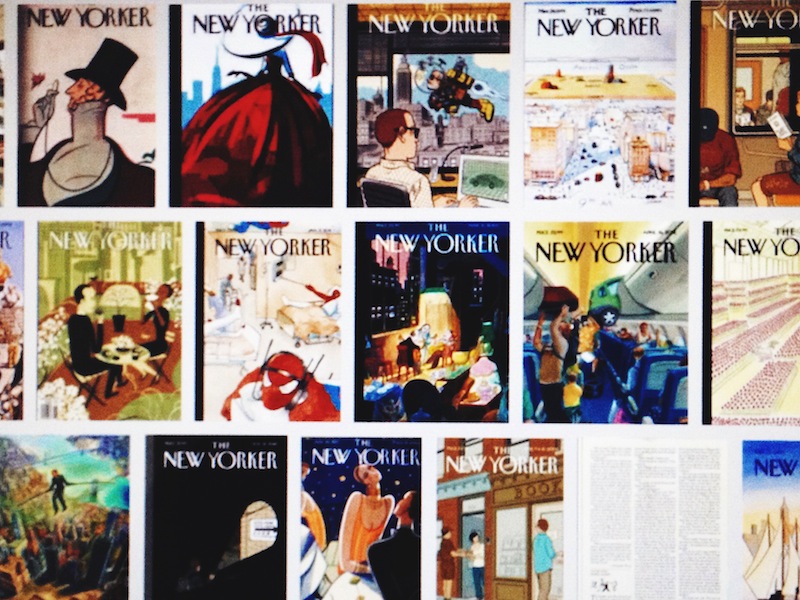 The New Yorker folks have been sharing some love with its readers recently, particularly so if you do enjoy reading longer pieces like myself. This summer, the American weekly magazine will overhaul the design of its online site, meanwhile temporarily removing its paywall. For all non-subscribers, this essentially entails access to its trove of archival materials since 2007. [Read the Editor’s Note HERE]
This is great news because the New Yorker is long been known for its well-researched pieces and to open their doors before launching its metered paywall similar to the system the New York Times currently adopts is a great move to let readers sample their work, in hope of bringing in even more future subscribers.
Below are some of the pieces I had read and enjoyed. Do tell me in the comment box below what are some other New Yorker articles that I should be reading.
View original post 237 more words
* Especially in dense, slow-moving traffic! (hat tip: tyler cowen)
From Chuck Klosterman’s (a/k/a “The Ethicist”) smug response to an ethical question posed by “K.M.” of Holden, Massachusetts:
I don’t think voicing your opinion falls anywhere on the ethical continuum … Ask [your two sons] if they’ve seriously considered the consequences of bringing new humans into a flawed world, while conceding that your personal view on this subject is (and should be) essentially irrelevant to whatever they ultimately decide to do.
Since Mr Klosterman himself is only offering his personal opinions to his readers’ various ethical queries, doesn’t his point above apply equally to the contents of his own weekly ethics column? (For the record, Klosterman’s self-refuting words appear (without irony) on page 13 of The New York Times Magazine on Sunday, 6 July 2014.)

What’s wrong with this picture?
Consider, for example, the recent spate of self-righteous indignation over Stephen A. Smith’s “provocation” comments or over the Israeli Defense Forces’ ongoing military operation in Gaza. Why do people disagree with the simple truth in either case–i.e. most violence is provoked, which, of course, is not to say that violence is ever justified (cf. the is-ought fallacy)? Perhaps it’s because some people don’t like updating their Bayesian priors, or as Jamie Whyte observes on page 9 of his beautiful book Crimes Against Logic, because some people don’t really care about truth: “If someone is interested in believing the truth, then she will not take the presentation of contrary evidence and argument as some kind of injury. It’s just that, on some topics, many people are not really interested in believing the truth. They might prefer it if their opinion turns out to be true–that would be the icing on the cake–but truth is not too important.” What say you?
Update (30 July): ESPN has suspended Stephen A. Smith for one week for (get this!) daring to speak his mind on the Ray Rice case. Thanks ESPN … the world is such a better place now!
Here’s a puzzle: Why do people gamble in casinos, especially if (as our old friend Freddie Torres would like to say when talking about lawsuits against the government) “the House always wins”? By way of example, check out this report by Chris Opfer about blackjack payouts in Las Vegas. Pay close attention to this part of Mr Opfer’s report:
But like skinning a cat, frying a fish, or badgering a cocktail waitress, there are several ways to squeeze more cash out of the gambling masses. One is to simply change the rules … In March, the Venetian and Palazzo casinos changed the payouts on blackjack hands from three-to-two to six-to-five. That might not seem like a big difference to casual observers, but experts say the change significantly increases the casinos’ house edge …
[One way to win at the game of blackjack] is by making a “blackjack” or “natural 21,” that is, drawing an ace paired with a king, queen, jack, or 10 in your first two cards. A player who beats the dealer usually get paid at a one-to-one rate. Bet $10, win $10. Getting a blackjack is a less frequent occurrence, and one that’s a bit more lucrative. Until recently, it was standard for casinos to pay out blackjacks at a three-to-two rate, meaning that a $10 blackjack hand pays the winner $15. At the Venetian and Palazzo, the same hand now pays $12.
“It’s like a hidden tax that you’re being charged by the casinos,” Henry Tamburin, a gambler, gaming instructor, and author of Blackjack: Take the Money and Run, says of the payout change. “Most people don’t realize that.” Tamburin says a player can expect to hit a blackjack about once every 21 hands. At an average of 80 hands an hour, that translates to the house snatching an extra $12 out of players’ hands every 60 minutes. Spread that over every player at every table at a casino and you can see why pit bosses might go all in on six-to-five.
In other words, “the House” not only decides which games to play; it can also literally change the rules of the game in the middle of the game! Notice, moreover, that this observation is true not only of casinos in Las Vegas but also of the game we call law. That is, ordinarily, a simple majority vote in Congress or in the Supreme Court suffices to change the rules of the law game. For example, Congress has the power to change the rules of the copyright game, while the Supreme Court has the ex post (and self-declared) power to review any changes made by Congress. But is majority rule consistent with the ideal of the “rule of law,” especially in the case of unelected and unaccountable Supreme Court judges? We don’t think so. In fact, if we could amend or re-design Article III of the U.S. Constitution (which, by the way, makes no mention of the power of “judicial review”), we would seriously consider imposing a two-thirds “super-majority” voting rule on the Supreme Court to limit the judiciary’s power to change the rules of the game. (Our modest rule-change proposal, though, is not without irony.)

Warning: the House always wins.








Hopefully It’s Interesting.
In Conversation with Legal and Moral Philosophers
PhD, Jagiellonian University
Books, papers, and other jurisprudential things
Ramblings of a retiree in France
BY GRACE THROUGH FAITH
Natalia's space
hoping we know we're living the dream
Lover of math. Bad at drawing.
We hike, bike, and discover Central Florida and beyond
Making it big in business after age 40
Reasoning about reasoning, mathematically.
I don't mean to sound critical, but I am; so that's how it comes across
remember the good old days...
"Let me live, love and say it well in good sentences." - Sylvia Plath
a personal view of the theory of computation
Submitted For Your Perusal is a weblog wherein Matt Thomas shares and writes about things he thinks are interesting.
Logic at Columbia University
Just like the Thesis Whisperer - but with more money
the sky is no longer the limit
Technology, Culture, and Ethics
Just like the horse whisperer - but with more pages
Poetry, Other Words, and Cats


 prior probability